





 English
TURN-KEY PCB ASSEMBLY: BITTELE ELECTRONICS
PCB MANUFACTURING AND ASSEMBLY
Full Turn-Key PCB Manufacturer
You can quickly get quotes and order PCB fabrication and assembly using our online system. Take advantage of exclusive automatic discounts with our tool. Our BOM pricing tool ensures you receive the lowest price for your order.
START A TURN-KEY PCB ORDER
Impedance Controlled Printed Circuit Boards (PCB)
Bittele Electronics provides stack-up and impedance calculations free of charge upon request. Our Field Application Engineers are ready to help you at any time, whether you just need some advice to design your own Controlled Dielectric, or you prefer to leave the full stack-up creation to us. We will work with your engineering team at the conceptual level of the PCB design to help you obtain better results in controlling impedance by selecting the proper PCB Laminate Material and Multi-Layer PCB Stack-Up.
Bittele's Stack-up Capabilities include:
- Free Stack-up
- Free Impedance Calculation
- Hybrid Build
- RF, Microwave, and other High Frequency PCBs
Bittele Electronics keeps common materials in our in-house inventory at all times. The common materials include:
- Higher copper weights: 2 oz, 3 oz; Heavy Copper PCBs (higher weights may require additional lead time)
- Asymmetric core copper weights: ½/1 oz, ½/2 oz, 1/2 oz
- Copper foil: ⅓ oz, ½ oz, 1 oz, 2 oz, 3 oz
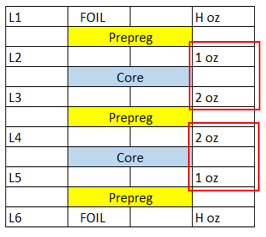
Consideration for Selecting Foil-built or Core-built PCBs
At Bittele Electronics, our usual preference is for Foil-Built PCBs in order to make the most economical PCB construction/stack-up. That being said, our PCB Manufacturing/Fabrication Process is very flexible, and we can utilize Core-Built PCBs as well. Foil-Built PCBs not only tend to be more economical than Core-Built PCBs, but they are also slightly easier to process. The pictures below illustrate the difference between the Foil-Built and Core-Built PCBs.

Foil-Built PCBs typically utilize one fewer core than the Core-Built PCBs in the stack-up. The outer layers consist of copper foil. In addition, copper foil in different copper weights is much easier to acquire. Foil-built construction can be used with a wide range of compatible laminate systems. Prepregs can also be less costly than cores, particularly when very thin dielectric layers are required.
Core-built PCBs use copper-clad cores for the outer portions of the stack-up, so there is no need to use separate outer-layer copper foil. Depending upon material availability, at times it may be difficult to acquire a core with asymmetric/different copper weights. This forces the PCB manufacturer to etch down the copper on the cores, which is costly since a good deal of labor is involved. Aside from labour, the PCB manufacturer must use a higher copper weight than what appears on the board, increasing material cost as well.
Impedance Calculations
Bittele Electronics uses the industry-standard Polar Instruments SI8000 to calculate impedance. We provide an impedance report and serialized TDR coupons with each shipment free of charge. Typically, designers use published prepreg values from the data sheet to calculate impedance. We have done extensive research over the years to find our expected pressed prepreg thickness, also known as the pressed dielectric/prepreg thickness. Using these values helps us refine our impedance calculations so they are closer to actual values on the finished PCB. This is why we encourage you to work with our team and experienced Field Application Engineers at the conceptual/design stage so that we can help you refine your impedance calculations.
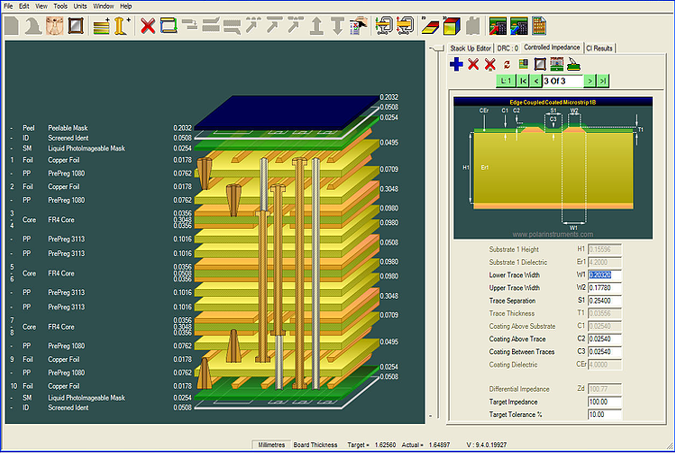
We run all manufacturing panels with at least 2 TDR coupons placed diagonally across the panel. Both coupons are serialized to panel and array (if present). As mentioned above, we provide serialized TDR coupons & reports with all of our shipments free of charge.